
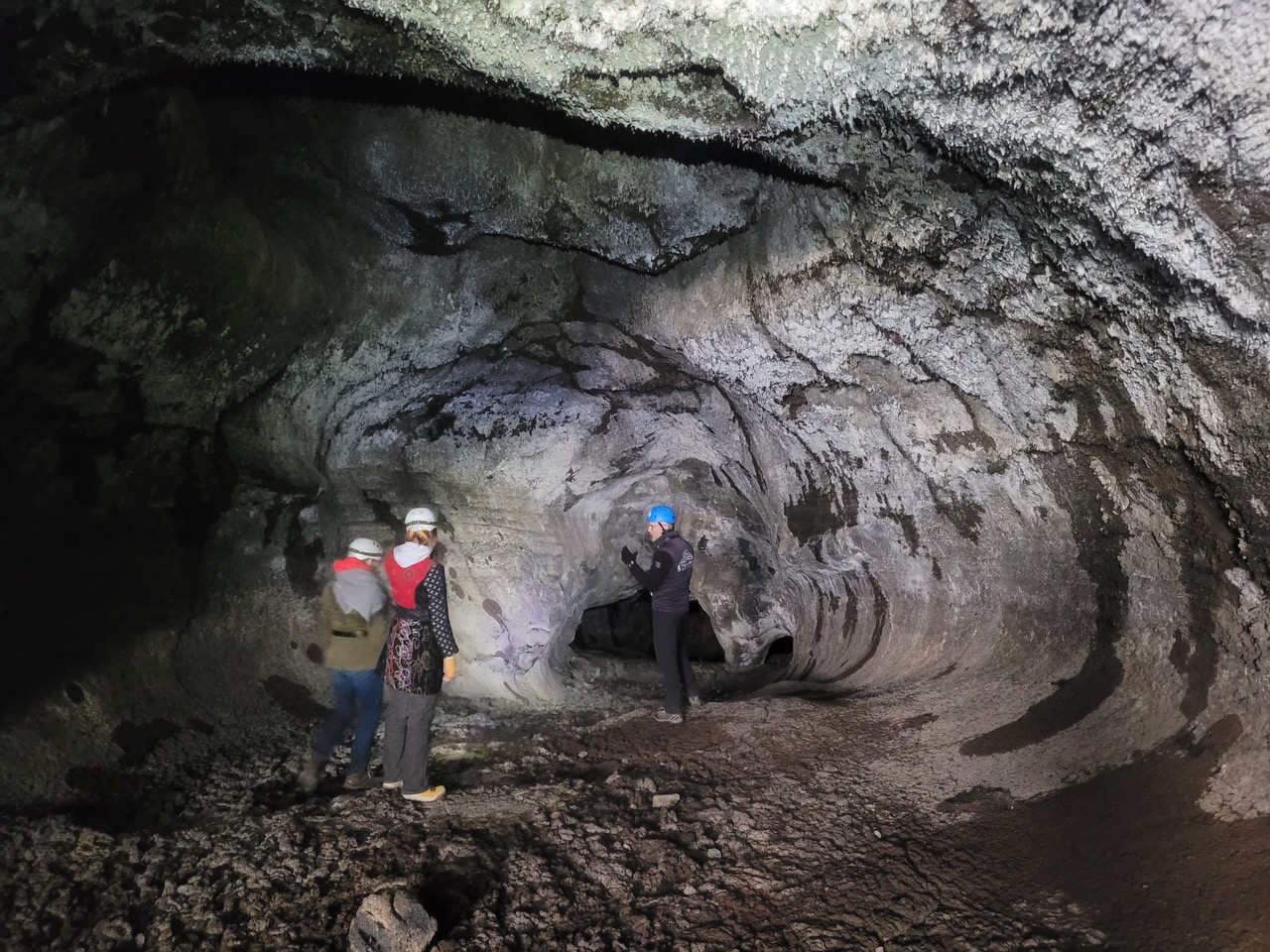
Mount Etna never ceases to amaze. Beyond its majestic craters and flowing lava fields, the volcano hides an extraordinary underground heritage: lava caves. These natural tunnels, formed during historic eruptions, offer a unique experience for those eager to discover Sicily’s most authentic and adventurous side. Let’s explore together the most spectacular caves of Mount Etna.
Grotta dei Tre Livelli: the queen of lava tunnels
Located at 1,625 meters above sea level in the Casa del Vescovo area, along the Zafferana–Rifugio Sapienza road, Grotta dei Tre Livelli is considered the most important lava flow cave on Mount Etna. With a total length of 1,150 meters and an exceptional vertical drop of 304 meters, it formed during the 1792 eruption, which lasted an impressive 370 days.
What makes this cave unique is its complex structure of three overlapping lava galleries at different levels, connected by small drops. Also known as the Bat Cave, it once hosted large colonies of these insect-eating mammals. The walls display fascinating remelted lava stalactites resembling glassy lava drips, along with ledge-like natural cornices. The upper part of the cave is particularly steep, reaching slopes of up to 40°, a rare feature among Etna’s lava tubes and worldwide.
Grotta Cassone: accessibility and charm
Situated at 1,455 meters above sea level just above Piano del Vescovo, Grotta Cassone is easily accessible and has long been a popular destination for tourists and enthusiasts. Like many caves in the area, it formed during the 1792 eruption.
Its easy access has made it one of the most visited caves on Etna, frequently included in guided nature tours. In recent years, it gained attention following a ceiling collapse that fortunately caused no injuries, highlighting the importance of visiting caves with experienced guides and respecting safety regulations.
Grotta dei Tre Livelli and Grotta Cassone can be visited during EtnaWay’s Etna South Tour.
Grotta dei Ladroni: history and legend in the eternal snow
At 1,550 meters above sea level, in the territory of Sant’Alfio near the Sartorius Mountains, lies Grotta dei Ladroni, also known as the Snow Cave. About 50 meters long, it carries a fascinating legend: in the second half of the 18th century, a group of bandits is said to have sought refuge here — unsuccessfully.
Its alternative name comes from its historical use as a snow storage cave. Through human intervention, three tunnels were carved connecting the cave to the outside, making it easier to store snow that was later sold in villages on the volcano’s slopes.
The cave has two entrances: one reached by a rock-cut staircase with ten steep steps, the other by an artificial slide-like passage. This dual access made the cave both easy to enter and a valuable escape route. In winter, ice formations can still be seen inside, evidence of its past as a snow depot.
It can be visited during EtnaWay tours: Family Tour | Etna 3000 Tour | North Craters Tour | Etna & Alcantara Tour.
Grotta di Corruccio: inside the volcanic cone
Located at 1,380 meters on Monte Corruccio near Piano Provenzana, this cave stands out for its unique formation. Part of it lies directly within the eruptive vent, while the rest extends into the lava flow.
With a length of 81 meters, the cave is divided into two sections by a major ceiling collapse, where a stone staircase has been built to ease passage. The upper section slopes noticeably and features a sharply pointed vaulted ceiling with a smooth lava floor.
The lower section has a trapezoidal shape, with an initial floor of volcanic sand and stones that transitions into smooth lava marked by large rope-like formations.
Also visitable during EtnaWay tours: Family Tour | Etna 3000 Tour | North Craters Tour | Etna & Alcantara Tour.
Grotta dei Lamponi: a tunnel through time
Situated at 1,750 meters in Passo dei Dammusi, Grotta dei Lamponi is one of Etna’s longest lava tunnels, stretching about 400 meters. It formed during the 1614–1624 eruption and is accessible via a dirt road from Linguaglossa into the pine forest.
The cave consists of two main galleries: one about 100 meters long downstream of the entrance, affected by numerous collapses, and another 300-meter section upstream in better condition. Entry is made through an opening in the ceiling, descending a steep slope of collapse debris.
The tunnel is mostly semicircular, sometimes elliptical with a horizontal major axis. The walls are richly decorated with remelted lava stalactites, grooves, and overlapping horizontal lava cords. Several skylights naturally illuminate the cave, making it well ventilated. The hollow sound of the lava floor reveals the complex structure beneath.
Grotta del Gelo: Europe’s southernmost glacier
At 2,030 meters beneath the spectacular Sciara del Follone lies Etna’s true gem — Grotta del Gelo (Ice Cave). Measuring 125 meters long with a 30-meter vertical drop, it preserves permanent ice and represents the southernmost glacier in Europe.
Formed during the 1614–1624 eruption, the cave maintains temperatures below freezing thanks to a natural ventilation system. The floor is entirely made of ice with embedded stones and emerging boulders, and in warmer months a large pool of water forms near the entrance.
Exploration requires special equipment: ice axes and crampons are essential for safety. The first section is flat, while the second slopes steeply over ice. The most spectacular sights are the ice stalactites and stalagmites, sometimes fused into columns and draped formations that change throughout the year.
In March 1981, an eruption nearly destroyed this natural wonder when a crater opened just ten meters from the entrance, volcanic ash covered the surrounding lava fields, and the ice retreated near the entrance. Fortunately, the cave survived and continues to preserve its ancient ice.
Grotta di Serracozzo
The trailhead lies on the right about 100 meters before Rifugio Citelli and is well marked. After about ten minutes of walking, a small sheepfold appears, beyond which the path turns left, crossing an area of Etna birch trees and channels carved into ancient lava flows — evidence of the area’s glacial past.
After roughly twenty minutes, the trail opens into a small valley where Grotta di Serracozzo lies, formed during the 1971 eruption. The low, narrow entrance requires caution and can be explored for about 50 meters only with a helmet and flashlight.
From the eruptive vents, the trail climbs steeply to a panoramic viewpoint over the Valle del Bove (2,095 m), along the Serracozzo ridge marked by visible magmatic dikes.
The easiest return follows the ridge to 2,150 meters and descends along the sandy Variant 723A, crossing the 1928 vents and reconnecting with the original path near the sheepfold. Longer, more demanding routes lead toward Rocca della Valle or Pizzi Deneri, where distinctive “cicirara” lava formations can be seen.
It can be visited during EtnaWay’s trekking tour.
Discover Etna’s caves with EtnaWay
Exploring Etna’s caves requires preparation, local knowledge, and strict attention to safety. EtnaWay is the ideal partner for experiencing this adventure safely while enjoying an unforgettable journey.
EtnaWay’s specialized guides know every corner of the volcano — every cave and every trail. With years of field experience and deep passion for Etna, they turn simple excursions into immersive journeys through the geological and human history of Europe’s tallest volcano.
Choosing EtnaWay means:
• Relying on certified volcanic guides
• Receiving all necessary safety equipment
• Accessing customized itineraries based on experience level
• Discovering stories and legends only locals can share
• Practicing sustainable and responsible tourism
Whether you wish to admire the ice formations of Grotta del Gelo, explore the three levels of the famous lava tunnel, or venture into the hidden passages of the Ladroni Cave, EtnaWay is your gateway to Etna’s underground world.
Visit www.etnaway.com and book your adventure through Etna’s caves.
The volcano is waiting for you!